Tuesday, April 21, 2009
Friday, March 20, 2009
Redefining Home: GreenovationTV Launches on Earth Day
Our mission: Help green the 130 million inefficient and sometimes unhealthy homes in the U.S. greenovationTV inspires viewers with practical advice and real solutions in a fast-paced and entertaining format. This isn't your daddy's fix-it-up show. greenovationTV is an internet television station with free 24/7 on-demand access to original short videos with everything consumers need to know about green home improvement.
It's about Real Homes + Real Improvement. It's about Redefining Home. If we're going to green every home in America, we need your help! Please visit www.Greenovation.TV and send us your photos, videos and stories about how you are saving energy & water and how you are greening your home. Join us on Facebook http://tinyurl.com/cjytjq
Join Dr. Anna Marie (from The Weather Channel) as she takes her 1970s ranch home kicking and screaming into the 21st Century. She's not doing an extreme makeover and she's not doing just a facelift, she's making her home clean and green. From the windows and doors to the paint on the walls, we have a real home with real solutions. If you're thinking about greening your home on your own, then don't miss Dr. Anna Marie's GIY segments on www.Greenovation.TV. Remember: A green home is a healthy home.
GreenovationTV: Real Homes + Real Improvement
Monday, February 16, 2009
Can a $1 Incensce Stick Save You $100s on Your Energy Bill?
You may already know where some air leakage occurs in your home, such as an under-the-door draft, but you'll need to find the less obvious gaps to properly air seal your home.
For a thorough and accurate measurement of air leakage in your home, hire a qualified technician to conduct an energy audit, particularly a blower door test. A blower door test, which depressurizes a home, can reveal the location of many leaks. A complete energy audit will also help determine areas in your home that need more insulation.
Without a blower door test, there are ways to find some air leaks yourself. First, look at areas where different materials meet, such as between brick and wood siding, between foundation and walls, and between the chimney and siding. Also inspect around the following areas for any cracks and gaps that could cause air leaks:
- Door and window frames
- Mail chutes
- Electrical and gas service entrances
- Cable TV and phone lines
- Outdoor water faucets
- Where dryer vents pass through walls
- Bricks, siding, stucco, and foundation
- Air conditioners
- Vents and fans.
You can also try these steps to depressurize your home to help detect leaks:
- Turn off your furnace on a cool, very windy day.
- Shut all windows and doors.
- Turn on all exhaust fans that blow air outside, such as bathroom fans or stove vents.
- Light an incense stick and pass it around the edges of common leak sites. Wherever the smoke is sucked out of or blown into the room, there's a draft.
If you don't want to turn off your furnace, you can just turn on all your exhaust fans to depressurize your home.
Other air-leak detection methods include the following:
Shining flashlight at night over all potential gaps while a partner observes the house from outside. Large cracks will show up as rays of light. Not a good way to detect small cracks.
Shutting a door or window on a piece of paper. If you can pull the paper out without tearing it, you're losing energy. You may as well just shove some $10s and $20s through those cracks while you're at it.
From U.S. Department of Energy Consumer's Guide to Energy Efficiency and Renewable Energy
Monday, January 19, 2009
Energy Inefficient: U.S. Trails Some Third World Countries

Published: January 18, 2009
. . . Per-capita carbon dioxide emissions by households in the United States and Canada are the highest in the world — in part because of bigger homes . . . READ MORE.
Tuesday, January 13, 2009
Tax Incentives to Help Trim Home Energy Costs
A force of public interest and government agencies is working to ease the financial crisis by revitalizing and adding tax incentives for homeowners across America under the Tax Incentives Assistance Project (TIAP).
Teaching an Old House New Tricks
Listen to the NPR story here:
Maybe a brand-new home equipped with all the latest technology isn’t in your budget. The Environment Report’s Lester Graham reports on another approach that takes an existing house and recycles it. Environmentally friendly architecture is becoming very common. Architects are designing innovative, cutting edge, energy-efficient homes, using renewable resources. But, Lester Graham reports on another approach that recycles an entire house:
You know, we’re always hearing about new green building construction - new homes with all the latest. That’s nice, but it’s a little ironic to think about all those resources being used to build new to save resources.
That’s why I kinda got interested when I read about Matt and Kelly Grocoff. They bought a modest, century-old house and started making energy-efficient changes. A lot of them as Matt showed me in the bathroom.
(stairs sound)
And that’s just the bathroom. As the couple took me upstairs, they
told me about the really, really efficient geo-thermal heat. They insulated everywhere. It’s tight. But everything was off-the-shelf. None of that, ‘oh this is custom, you can’t buy it anywhere’, type stuff.Kelly Grocoff says if your house is a statement about you, then having a low-impact on the earth’s resources and reducing greenhouse gas emissions is part of the statement they want to make.
“For us, we proclaim loud and clear 'this is where our values are. And this is where we’re going to spend our time and it’s incredibly important to us'.”
And with all the efficiencies, all the updates, the house looked normal, comfortable. And the Grocoff’s say that’s the way it should be.
Matt: “One of the things with building green, everyone thinks that you’re going to sacrifice something, you’re going to spend more money and you’re not going to be as comfortable. And that is completely not true anymore.”
Kelly: “We have made zero sacrifices. We have gained enormously. And we have no time to waste. Your house is the number one place where you can make a significant impact on a daily basis. For me there’s no other choice to be made.”
Matt and Kelly Grocoff say doing something about reducing energy use, reducing the emissions that are causing global warming, and re-using old lumber and this old house is just a start for them. They want to help other people do it too. That’s why they’re launching an online site for do-it-yourselfers called ‘GreenovationTV.com’
Matt: “Uh, through Greenovation TV, we’re going to take everything that we’ve learned from this house and teach others about it.”
Kelly: "We need that kind of resource there as we're going through this process. And so there was hours upon hours spent researching things. And that's kind of the goal with this station."
Matt: "Once you have the knowledge to do it, it's really, really easy."
The Grocoff’s say the one thing holding people back from making their homes more environmentally friendly is they feel like they have to do it all or it won’t be right. They say just take the first step. Even if it’s just changing to a lower-energy compact fluorescent bulb, it’s a good start.
For The Environment Report, I’m Lester Graham.
Monday, January 12, 2009
Nine home renovation projects that make sense for 2009
. . . Hint . . . the best bangs for the bucks are good for the planet and your wallet too.
By Karen Klages | Tribune reporter
With sales of existing houses in the Midwest down 6 percent in October (and remain 9.1 percent below figures from October '07) and the median Midwestern home price down 6.7 percent from a year ago (according to the National Association of Realtors), it makes sense for homeowners to think at least twice about investing in a renovation.
What projects make sense, given the state of economic affairs? What improvements will allow folks to live better now and make the house more saleable later—and offer a handsome return on investment? READ MORE
Thursday, November 6, 2008
New $2000 Tax Credit for Geothermal Heating & Air!!


An exciting new tax credit is now available for home and commercial building owners who install geothermal heating and cooling systems through the Energy Improvement and Extension Act of 2008 (H.R. 1424). H.R. 1424 offers a one time tax credit of 30% of the total investment (maximum of $2,000 for a single residence) for all residential ground loop or ground water geothermal heat pump installations. A credit of 10% of the total investment is also available (no maximum) for a commercial system installation.
To qualify, the systems must meet or exceed EnergyStar requirements and be installed after December 31, 2007. Owners can file for the credit by completing the Renewable Energy Credits subsection on their tax return forms for 2008. For taxpayers that are subject to the Alternative Minimum Tax, they can claim the credit on their taxes for the following year. No proof of purchase will be required; however, in case of an audit, owners are encouraged to keep a detailed invoice of their purchase on file. The contractor who sold and installed the product should list the purchase as a "Geothermal Heat Pump" on the invoice and that it "Exceeds requirements of Energy Star program currently in effect".
The tax credit is available from October 3, 2008 through December 31, 2016. For more information, visit http://thomas.loc.gov or contact your local tax professional.
Visit http://www.dsireusa.org/ to find additional tax incentives that may be available in your state.
Monday, August 4, 2008
The Economic Upside Of Historic Preservation
By: Jon Zemke, 7/9/2008 from ConcentrateMedia
Matt and Kelly Grocoff picked an ugly ducking of a house when they bought their century-old Old West Side abode two autumns ago. While others saw an old, dilapidated structure --with the buzz words that make homebuyers run: lead and asbestos-- the Grocoffs saw an opportunity to do something special at bargain basement rates. They saw history, and they made their own mark on it.
"It's one of those things where people didn't see what was beneath the lead paint and asbestos," Matt Grocoff says. "You have a structure that has lasted 100 years and could easily last another 100 years if it's maintained."
Less than two years later the couple has transformed the Folk Victorian-esque home on the western edge of one of Ann Arbor's most celebrated historic neighborhoods into an eco-dream house. Read More
Wednesday, June 25, 2008
Finally, An Easy Way to Recycle CFLs

Home Depot Offers Recycling for Compact Fluorescent Bulbs
From the New York Times
By STEPHANIE ROSENBLOOM
Published: June 24, 2008
Some big retailers are promoting compact fluorescent light bulbs as a way to save energy. But improper disposal of the bulbs creates a hazard, because they contain small amounts of mercury.
Recycling them is about to get easier. Home Depot, the nation’s second-largest retailer, will announce on Tuesday that it will take back old compact fluorescents in all 1,973 of its stores in the United States, creating the nation’s most widespread recycling program for the bulbs. Click here to read more
Friday, May 23, 2008
Until the Sun Shines Out Your Ars . . . Use a CFL
I couldn't resist sharing this wonderful video encouraging energy efficient lighting.
Send this post along to friends and tell them to "SCREW OFF". That's right. Screw off those old-school wasteful bulbs and light up your energy savings now.
Stay tuned for an upcoming post about that nasty mercury in compact fluorescent bulbs and why they are still better for the planet than incandescents.
Friday, April 4, 2008
Aged and Ripened . . . but Still Green: Part II
Easy Steps to Saving Hundreds on Your Energy Billsby Kelly and Matthew Grocoff
Part 2 of 3 articles (to read Part I visit our blog at GreenovationTV.com)
Originally published by the Sierra Club Huron Valley Group
(Photo of the Grocoffs by Cybelle Codish)
Green home renovations are not just a passing phase. According to the USGBC, our homes use 21% of the energy consumed in the U.S., and home energy costs have skyrocketed to an average of $3800 per year. In the near future, all homes will be built green. But, the average age of an American home is now over 30 years. That's a lot of room for energy efficiency improvements. Every year that energy prices rise, and they certainly will, investments in efficiency get better and better. Greenovations are simply the best way to future-proof your home and make it more comfortable and affordable today.
When renovating our 107-year-old home on Ann Arbor's historic Old West Side, we divided our process into four parts: 1. Energy (reduction & production) 2. Water efficiency 3. Materials and resources, and 4. Indoor environmental quality. These are not separate categories, but rather integrated parts of the whole which must be considered together. For the biggest bang for the carbon buck, we begin with energy efficiency. Later, in Part 3 of this series, we'll discuss water, materials and indoor environment.
Green Bling vs. Reduce then Produce
When considering cost-saving (and human species-saving) energy efficiency improvements, most of us immediately begin thinking about the shiniest, newest, most visible things that everyone is talking about - the "green bling": solar panels, wind turbines, and a Prius in the driveway. While these are all simple and available technologies that must be adopted as soon as possible, reducing the energy load is much more affordable and is an essential first step.
Reduce then produce. Any target of net-zero energy use from the grid must begin by reducing your load. As has been said many times, "efficiency is the cheapest power plant in the world." Once we reduce our load as much as possible, then we can look for sustainable renewable resources to produce what is needed for the remaining load.
If it Ain't Tight, it Ain't Right
Before considering the green bling and that new geothermal or solar thermal system, we knew we had to tighten up the house. By taking the following steps to reduce your load, it will make your home immediately more comfortable, lower your energy costs (no matter what system you currently have) and will make it less expensive for you when it comes time to bring in the bling. Step 1: Consider an Energy Audit, Step 2: Find and seal air leaks, Step 3: Insulate, Step 4: Consider sealing and improving old windows (not necessarily buying new).
Using sophisticated technologies like infrared cameras or blower door pressure tests, a professional energy auditor can help you find where your house is performing poorly and recommend affordable changes. The reasonable fee they charge will pay for itself quickly if you follow their recommendations.
You can also try an easy do-it-yourself air leak test. On a very cold day, we took a lighted incense stick and waved it close to our doors, basement joists, windows and upstairs ceiling fixtures. We could see the air changes in the blowing pattern of the smoke. The bigger the gap, the more the smoke moved. These were all air leaks that we needed to fix.
This little trick will only tell you about air gaps. It won't tell you how well your home's walls and attic are insulated. For us it was easy, our attic was insulated with one layer of newspaper from 1902. We didn't need an infrared test to know that there was room for improvement. (Click here to learn more about home energy audits)
Are You Leaving A Window Open All Winter Long? - Detecting Air Leaks
Up to 30% - 50% of home energy costs come from heat loss! Tiny gaps around things like your windows, doors, vents, and light fixtures are the single biggest cause of home heating and cooling loss. All those tiny cracks and gaps can add up to 10 sq ft or more. That's like leaving a window or door wide open all winter long!
Depending on the size and location of the gap, you can use caulk or a foam sealant such as Great Stuff (go to greatstuff.dow.com for great interactive help on sealing your home). Before insulating our attic with blown cellulose, we hunted around for every possible air gap around the chimney, light fixtures that opened to the attic, wall seams, etc and sealed them tight with spray foam. If you insulate your attic with spray foam insulation, rather than cellulose, this step is not necessary.
Next we tightened up the windows by caulking around the frames and by using rope caulk ($5.77 at Lowes) to seal gaps in between the double hung windows. The rope caulk can be easily removed and is reusable. This is a temporary solution, but it works like a charm. Further, adding exterior storm windows can be nearly as effective as replacing older windows with new ones.
And of course, we made sure we had new weatherstripping around all of the doors to prevent that blast of air that finds its way under the doors.
For even deeper efficiency, we made sure our geothermal contractor followed Code and sealed and insulated all of our ducts. According to Energy Star, sealing and insulating ducts can improve the efficiency of your heating and cooling system by 20 percent — and sometimes much more! (Click here for more about air sealing and insulating your home)
A Warm Cozy Blanket for Your House
Now that we've zipped up our jacket, we're ready for a warm blanket to wrap around the house. There are great benefits to both blown cellulose and spray foam insulation. Your wall type, current insulation type and your budget will all be considerations when choosing insulation. In our attic and walls we went with blown cellulose, made from recycled newspaper. Farmer's Insulation was able to cleanly remove some of the original wood siding and blow the insulation from the outside of the house, without damaging the historical integrity of the siding.
Basement joists are among the worst offenders for heat and air loss. We chose Arbor Insulation to fill all of the cavities between the foundation and the first floor with open-cell spray foam. This provided both an excellent air seal for all those nasty gaps, as well as a significant thermal barrier to hold the heat in the basement. Be sure to avoid using any foam insulation that contains ureaformaldehyde or cellulose insulation that uses aluminum or ammonium sulfate instead of boric acid as a fire retardant.
Lights Are On . . . But Nobody's HomeLighting accounts for 12% of home energy consumption. As much as 60% of lighting cost are for lighting empty rooms. So, first we replaced all the lights with compact fluorescent bulbs. This gives us a huge savings each year in electricity and long term savings for having to change the bulb only every 5 years.
Next, we installed Wattstopper motion sensor light switches throughout the house. These turn lights off automatically when the room is empty. Wattstoppers cost a bit more, but pay for themselves in a short time. (Note: ordinary light switches have a pay back time of never).
Digging Deep for Energy Efficiency - Bring in the Bling!
Heating and cooling can burn half of your energy dollars each year. When we moved into our folk-Victorian, the circa-1957 Mueller Climatrol gas furnace operated at about 40% efficiency. For every energy dollar we paid to the utility company, 60 cents went out the chimney and only 40 cents went to heat the house.

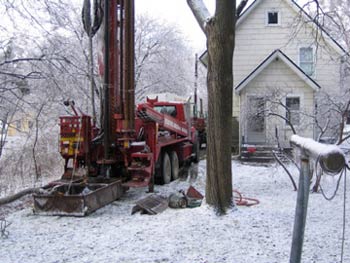
We carefully did the math on options like solar thermal heating, photovoltaic panels (solar electric), solar domestic hot water and other high efficiency heating and cooling systems. The hands down winner for us was geothermal. For every $1 we spend on electricity to run the geothermal, we get $4 worth of heat in the house - making our system 400% efficient. The U.S. Environmental Protection Agency calls geothermal "the most energy-efficient, environmentally friendly heating and cooling technology available." It provides heating, cooling and hot water all in one hyper-efficient system.
The Cost: We can hear you asking "but isn't it really expensive?" We believe that it is more expensive not to install geothermal - both to your pocket book and the environment. Our annual heating, cooling and hot water bill is projected to be only $523! Yes, our geothermal system cost several thousand dollars more in initial costs compared to far less efficient Energy Star heater, air conditioner and hot water heater. But, by working the cost of our geothermal into our mortgage when we purchased the home, the additional capital cost is only $45 per month.
The Savings: We're proud to report that we had an immediate positive cash flow when we turned on the system last year. In February 2007, prior to installing geothermal, our heating bill was $340. In February 2008, our bill was only $100.
Now that we've reduced our energy consumption by more than half, we are exploring the options for producing our remaining energy with renewable resources such as solar electric and even small vertical wind turbines. Someday, we hope to see municipal wind farms operating across the country and every roof producing some of its own energy. In the meantime, let's all do what we can to tighten our homes as best we can. And don't forget to turn out the lights.
Links to green stuff to help greenovate your home
Thursday, March 27, 2008
Green Stuff We Recommend (or How We Greened Our 107 Year Old Home)
1. Energy Efficiency:
Find a contractor anywhere in the U.S.
Geothermal Contractors in Ann Arbor:
Meadowlark Builders, (734) 332-1500
Michigan Energy Services, (888) 339-7700
Haley Mechanical, (800) 871-7993
Jetstream Heating & Cooling, Geocomfort System - Tom Fauser (734) 668-8010
Fact: U.S. Environmental Protection Agency (EPA) has said geothermal heat pumps are, "the most energy-efficient, environmentally clean, and cost-effective space conditioning systems available today."
Occupancy sensors - Wattstopper on all light switches - turns off lights automatically in unoccupied rooms. California now requires these in all new home construction.Installed by Dan Delzoppo Electric
Available at Gross Electric in 2232 South Industrial Hwy., Ann Arbor, MI 48104 (734) 665-8676
Available online at EcoHaus
Installed by:
Farmer's Insulation in Ann Arbor - Guy Murphy
Note: Our infrared camera test showed excellent coverage. Great job Guy!!
Learn more
Arbor Insulation
sales@arborinsulation.com
Change to appliances that have earned the ENERGY STAR, and you could save hundreds of dollars a year in energy costs, while saving the environment.
"A household that invested $90 in changing 30 fixtures to CFLs would save $440 to $1,500 over the five-year life of the bulbs, depending on your cost of electricity. Look at your utility bill and imagine a 12% discount to estimate the savings." The End of the Light Bulb as We Know It. US News & World Report, 19 December 2007.
Great Stuff foam for sealing around window casings, basement gaps, chimneys, attics, etc. When you add up all the little gaps in your house, it can be the equivalent of leaving a window open all year long. Check out the Great Stuff website "Interactive House" for cool tips on sealing your home.
Check out the Brill Luxus 38 and the all new Brill Razor Cut 38
We LOVE these mowers!! This ain't your granddaddy's push mower. You'll wonder why anyone uses hard to push, noisy, smelly, polluting gas mowers.
Smart Strip - WE LOVE THIS!! Power strip designed to kill that Vampire Power that is sucking hundreds of watts . . . even when you're not using your electronics. Click "shut down" on your computer or "off" on your TV remote and it will automatically turn off all the peripherals too - DVD, Wii, surround sound, printer, fax, hard drives, or whatever. It will pay for itself in a few short months. Available online at Amazon and other retailers.
2. Water Efficiency:
The Average U.S. Home Uses 300 - 700 gallons per day! Look for the new EPA Watersense label for outstanding water savings.
A family of 3 will save around 11,000 gallons of HOT water every year. This is not only a water saver, but a huge energy saver as well. This brilliant technology will pay for itself in as little as 7 months!! Every shower should have one of these. No more excuses. Simply the best shower you can get.
Online Retailers $64.95: Black Energy and EFI
Find a Caroma Retailer: http://www.caromausa.com/distributors/
Available online: BuyPlumbing for under $400
Rainwater capture used for irrigation - We got ours made from reused Michigan oak wine barrels from St. Julian Winery. There are plenty of places to buy rain barrels or you can make your own. Believe it or not, for every inch of rain that falls on a catchment area of 1,000 square feet, you can expect to collect approximately 600 gallons of rainwater. 5 inches of rain falling on a 2,000 square foot roof area will generate about 6,000 gallons of rainwater!3. Materials:
Bioshield Floor Coatings. Antique heart pine floors sanded then refinished using natural penetrating Bioshield Hard Oil #9 for a durable, water resistant and non-toxic finish. You can often catch great closeout deals on the Bioshield website.Find a retailer
New Hudson MI 48165 (US)
Phone: 248-437-1370
Bathroom floors made from second hand marble. Highly durable.
Medicine chest mirror made from antique picture frame.
Other Materials Considerations:
Reused salvaged trimwork wherever possible
Sustainably Harvested Wood: When buying new wood, insist on Forest Stewardship Council‘s FSC Certiciation or Rainforest Alliance Certification.
Donate excess materials for reuse - Habitat for Humanity Restore or Ann Arbor Reuse Center
Compost bins for yard and kitchen scraps
1 Gallon trash can in kitchen - prevents us from creating too much waste for landfill
Compost pail at kitchen sink to collect kitchen scraps for compost - not the disposal or trash.
Reclaimed brick walkways - reuses material and minimizes stormwater runoff.
4. Indoor Environmental Quality:
Fact: Indoor air is sometimes three times more polluted than outdoor air. According to the EPA, poor indoor air quality is considered to be one of the top 5 hazards to human health. Paints and finishes, furniture, flooring, wood & cabinet adhesives, mold and poor ventilation are among the leading causes.
Major brands (sometimes cost a little less and are now widely available) FreshAire Choice from Home Depot, Olympic Premium Paint (Available at Lowes), Pittsburgh Paints, Sherwin Williams Harmony (NOTE: Harmony is NOT GreenSeal or GreenGuard Certified and is only a "low"-VOC rather than zero-VOC) and others. Just make sure you ask for Zero-VOC paint at the paint or hardware store.
Available at
Gross Electric - 2232 South Industrial Hwy., Ann Arbor
Online at WestsideWholesale ($130 - $160) Plumber's Surplus ,
Zero or Low-VOC Adhesives: Henkel Green Series zero-VOC adhesive for sub-floor in new bathroom. You will love the ways these clean up!! No more nasty chemicals to remove the other nasty chemicals that get stuck on your hands. Best of all . . . almost NO SMELL.
Furniture: antiques or reused are the best - Craigslist, Freecycle, or eBay - But, if you must buy new make sure it is durable and free from toxic brominated flame retardants (PBDEs / BFRs), PVC or formaldehyde and is made from FSC or Rainforest Alliance certified wood. Many major brands are going green. Check these out: Crate & Barrel, Lee, Bob Williams+Mitchell Gold. Also, look for products that are C2C (Cradle 2 Cradle) certified.Rugs and Floor coverings made from natural materials - free from toxic flame retardants (PBDE) or vinyl

Our Wish List:
Energy Recovery Ventilator - ventilate fresh air and recover 80% of heat loss ($700 - $2,000 installed)
Solar and/or Wind Power to provide our remaining energy load ($30k-$50k)
Solatubes for natural daylighting in the closets and dark spaces. ($300 each)
More forward thinking political leaders
Tell us what is on your greenovation wish list . . .
Monday, March 24, 2008
Digging Deep for Energy Savings
Here's a great article on Matt & Kelly's geothermal system from MetroMode magazine:
Many alternative energy sources have an associated mental image -- fields of windmills sprouting like flowers in a field come to mind -- but what does your brain conjure up when confronted with the term geothermal?
Even if you know what geothermal is, you might have some trouble picturing it. Which makes sense because geothermal's magic happens below the earth's surface. Chances are a home or business you are familiar with already takes advantage of this not-new-at-all technology to heat and cool their premises while spending up to 70% less on their utility bill.
Is your interest piqued? READ MORE . . .